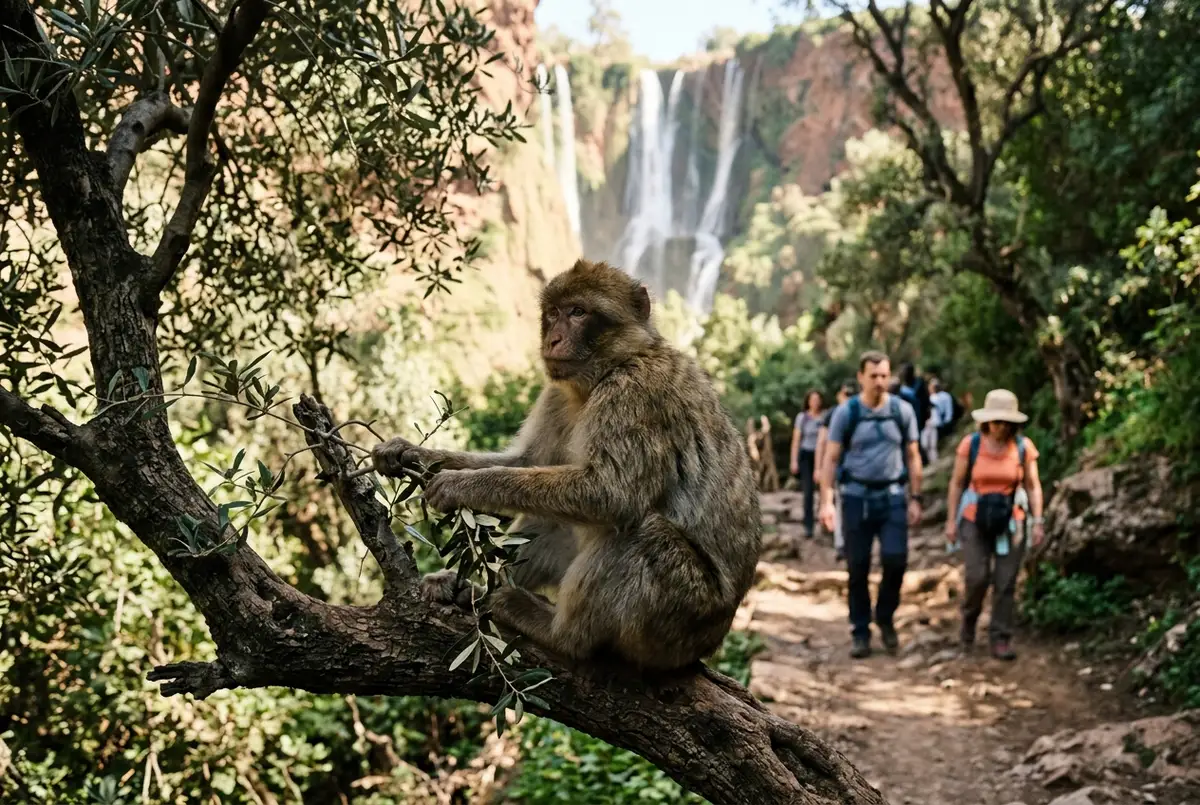
Ouzoud monkeys are wild Barbary macaques, one of the few primate species found outside Asia and sub-Saharan Africa, and they live in the olive groves lining the trail down to the falls. I would treat a sighting as one of the genuine highlights of the day, not a sideshow, since this is an endangered species you are unlikely to see wild anywhere else on a standard Morocco itinerary.
What Kind of Monkeys Live at Ouzoud?
They are Barbary macaques, Macaca sylvanus, a stocky, tailless monkey species native to the Atlas Mountains and a small population in Gibraltar. I find people often expect something closer to the long-tailed monkeys of Southeast Asia, and the tailless, ground-dwelling build of the Barbary macaque tends to surprise first-time visitors who were not expecting quite this look. Adults typically live in troops of a dozen or more, foraging together through the olive groves, and I think watching the social structure of a troop, the grooming, the youngsters play-fighting, is honestly as interesting as spotting an individual monkey up close.
Where Exactly Will You See Them on the Trail?
Most sightings happen in the olive groves on the upper part of the descent, close to where guided tours stop at the argan oil cooperative, rather than right at the water’s edge. I would keep your camera accessible during this stretch specifically, since this is genuinely the highest-probability window for a close encounter on a typical visit. The trail narrows in places through this section, so I would also keep both hands as free as possible here rather than juggling bags, water bottles and a phone all at once.
Are the Barbary Macaques Dangerous to Visitors?
Generally no, though I would never call a wild animal harmless. These macaques are habituated to tourists and rarely aggressive unless they feel cornered or are chasing visible food, so I would keep a respectful distance and let them approach or ignore you rather than the other way around. Bites and scratches do happen occasionally when visitors try to feed or touch them directly, which is exactly the behavior I would avoid. I would also keep small children within arm’s reach around the troops, not out of real danger, but because the monkeys are quick and unpredictable in a way that can startle a young child more than an adult.
Should You Feed the Ouzoud Monkeys?
No, and I feel strongly about this one. Feeding wild macaques encourages aggressive begging behavior, disrupts their natural diet, and puts both visitors and the animals at real risk over time. I would keep all food zipped away in a bag rather than in a pocket, since these monkeys are quick and experienced at spotting an easy target. I would also avoid buying from anyone offering peanuts or bread specifically to feed the monkeys along the trail, since that practice is exactly what conservation groups working in the Atlas Mountains are trying to discourage.
Why Are Barbary Macaques an Endangered Species?
Habitat loss, illegal capture for the pet trade, and human-wildlife conflict have all contributed to a steep population decline across their Atlas Mountains range over recent decades. I think that context is worth carrying with you on the trail, since it turns a fun photo opportunity into something with a bit more weight: you are looking at one of the more threatened primate populations left in North Africa. Tourism at sites like Ouzoud, done responsibly, actually helps the case for protecting this habitat, since a healthy population of visible macaques gives the local economy a real incentive to keep the surrounding olive groves and forest intact rather than clearing them.
What Time of Day Gives You the Best Chance of a Sighting?
Morning departures tend to produce more sightings, in my experience with how these tours are typically timed, since the macaques are most active foraging in the cooler hours before the trail gets busy with midday crowds. I would push for an early pickup if seeing the monkeys is a priority for you specifically, rather than leaving it to chance on a later departure.
How Should You Photograph the Monkeys Respectfully?
Use a zoom lens or your phone’s zoom function rather than closing the physical distance, and I would resist the urge to get a close-up selfie with a wild animal no matter how habituated it looks. My photo spots guide covers the best general angles and light at the falls if photography is a priority for your visit.
Will a Guide Help You Spot Them?
Yes, and I would consider this one of the more underrated benefits of a guided hike over walking the trail alone. Local guides know the spots where troops tend to gather on a given day and can point them out before you would have noticed them yourself, which meaningfully raises your odds of a good sighting and a good photo. They also tend to know when to pause and wait quietly rather than walk straight through, which in my view makes a genuine difference to how close and how calm an encounter turns out to be.
What Should You Wear or Carry Around the Monkeys?
Nothing that dangles or flashes, in my honest opinion. Sunglasses pushed up on your head, loose jewelry, and anything shiny hanging from a bag strap can all attract curious attention from a troop, and I would tuck those away before you reach the olive grove section of the trail. A closed backpack with zips fully done up is the simplest precaution, and it costs you nothing to take.
Do the Monkeys Live Near the Berber Villages Too?
Yes, the same olive groves and farmland that support the local Berber villages around Ouzoud also support the macaque population, since both depend on the same terraced agricultural landscape. My history and Berber villages page covers more of that shared landscape and the communities living in it.
Does the Season Affect How Many Monkeys You See?
I would say yes, loosely. Cooler months tend to concentrate the macaques closer to the trail where food is easier to find, while during hotter, drier stretches they range more widely into the surrounding hills. My best time to visit guide covers the fuller seasonal picture if timing your trip around wildlife and weather both matters to you.
Are There Other Wildlife Sightings Worth Watching For?
Beyond the macaques, keep an eye on the cliffs themselves, since various birds nest in the rock faces behind the spray and are visible if you pause at the right viewpoint rather than moving straight through. My complete Ouzoud waterfalls guide rounds up the wider picture of what to expect on a visit beyond the wildlife alone.
Do the Monkeys Ever Approach the Swimming Pools Below the Falls?
Occasionally, though I would say most sightings still cluster higher up in the olive groves rather than right down at the water. If you are planning to cool off in the pools after your walk down, I would not expect a monkey encounter at that stage, but it is not impossible. My swimming guide covers where those pools are and what conditions to expect.
So Should You Expect to See Monkeys at Ouzoud?
In my experience following how consistently these sightings get reported, yes, most visitors see at least one troop somewhere along the trail, especially on morning departures. I would still manage expectations honestly: they are wild animals, not a scheduled show, so a sighting is likely but never guaranteed. What I would guarantee is that the sighting, if you get one, tends to be the moment people remember most clearly from the whole day, more than the falls themselves in a lot of the accounts I have come across.
The IUCN Red List entry for the Barbary macaque confirms the species’ endangered status and its limited range across the Atlas Mountains and Gibraltar.
Want the best odds of a good sighting? Reserve the Ouzoud Waterfalls guided hike and boat tour and let a local guide lead you straight to where the troops tend to gather.
Frequently Asked Questions
What kind of monkeys live at Ouzoud Waterfalls?
Wild Barbary macaques, a tailless, endangered monkey species native to the Atlas Mountains.
Is it safe to see the monkeys at Ouzoud?
Generally yes if you keep a respectful distance and do not attempt to feed or touch them, since they are habituated but still wild animals.
Where on the trail are you most likely to see the monkeys?
In the olive groves on the upper part of the descent, near where most guided tours stop at the argan cooperative.
Should you feed the Barbary macaques at Ouzoud?
No, feeding encourages aggressive begging behavior and disrupts their natural diet, and it is not recommended by any responsible tour operator.
see everything else worth knowing about ouzoud waterfalls →